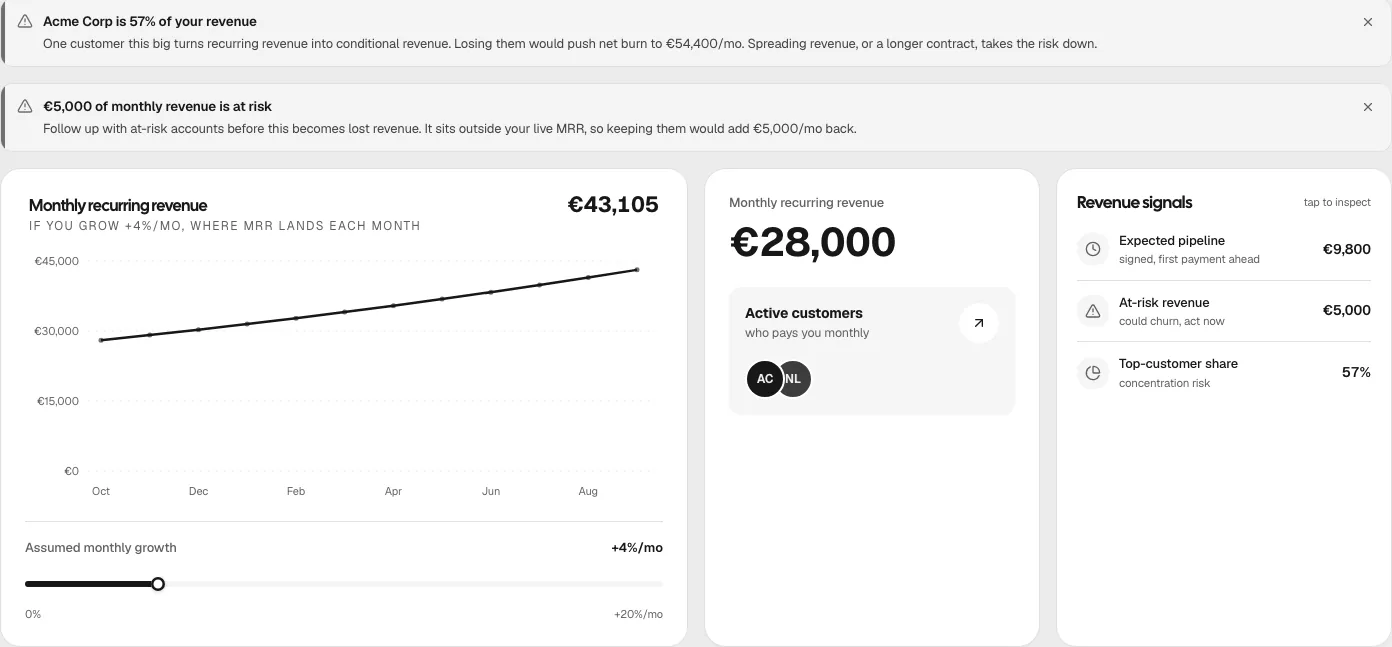
Customer concentration risk is the exposure created when one account supplies a large share of revenue. Calculate that share, then compare runway with and without the customer. The example below has 35% of MRR in one account: runway falls from 9.7 months to 7.5 if that customer stops paying today.
The rest of this guide runs that test on the example company, then covers where to draw the lines and what to change first.
The example
The example is a B2B startup whose largest account pays €9,100 of its €26,000 MRR, or 35%. With €310,000 in the bank and €58,000 of monthly costs, it appears to have 9.7 months of runway, and the founders are about to hire on the strength of that number. The figures:
- €310,000 in the bank
- €58,000 of monthly costs
- €26,000 of MRR, of which the largest account pays €9,100
Its runway today is 310,000 / (58,000 - 26,000) = 9.7 months.
How do you work out customer concentration?
Customer concentration is the largest customer's MRR divided by total MRR: here 9,100 / 26,000 = 35%. Then do the same for your top three customers combined, since a few large accounts can carry as much risk as one. Here is the whole book of ten customers:
| Rank | MRR | Share of MRR | Running share |
|---|---|---|---|
| 1 | €9,100 | 35.0% | 35.0% |
| 2 | €4,300 | 16.5% | 51.5% |
| 3 | €3,200 | 12.3% | 63.8% |
| 4 | €2,500 | 9.6% | 73.5% |
| 5 | €2,000 | 7.7% | 81.2% |
| 6 to 10 | €4,900 | 18.8% | 100% |
The top-three share is (9,100 + 4,300 + 3,200) / 26,000 = 16,600 / 26,000 = 63.8%, so three customers decide whether the company reaches next year. A top-three share above half is a similar problem to one large account, just spread across three renewal dates instead of one. MRR built from the customer list gives you the denominator, and a customer list with revenue share and status keeps the ranking in front of you.
Check the trend as well as the level. Concentration rises without any new big deal: the large account adds seats, a few small customers cancel, and a share that was 28% in spring is 35% by autumn. That is the usual way founders miss it. It looks like the business is growing, and the biggest account is growing fastest.
What does the largest customer's contract say?
Before you model anything, find four facts in the largest customer's contract: the notice period, the renewal date, whether they can terminate for convenience, and their payment terms. Together they decide how soon the revenue can stop and how soon the cash arrives. The four facts:
- The notice period. How long they must keep paying after they decide to leave.
- The renewal date, and whether it renews automatically.
- Whether they can terminate for convenience, or only for cause.
- Their payment terms. Large companies often pay on 60 or 90 days, which the payment terms guide covers in detail.
Say the contract renews in five months, with 90 days' notice, and no termination for convenience. The same question applies to an agency or retainer business: the largest client's notice period and monthly retainer go into the sum below in the same way.
How do you run the runway without your biggest customer?
Run the runway twice: once as things are, and once without the customer. In the example, losing the €9,100 customer takes runway from 9.7 months to 8.2 with 90 days' notice, or 7.5 if they stop paying today. Without the customer, MRR falls to €16,900 and net burn rises to 58,000 - 16,900 = €41,100 a month.
| Scenario | Months at €32,000 burn | Cash left then | Months at €41,100 burn | Total runway |
|---|---|---|---|---|
| They stay | 9.7 | €0 | 0 | 9.7 months |
| They give 90 days' notice today | 3 | €214,000 | 5.2 | 8.2 months |
| They stop paying today | 0 | €310,000 | 7.5 | 7.5 months |
The last row covers a customer in financial trouble, or one that gets acquired, which can stop paying before any notice period plays out. Treat it as the floor.
If the top two customers left, MRR would drop to 26,000 - 9,100 - 4,300 = €12,600 (a loss of 51.5% of MRR), net burn would be 58,000 - 12,600 = €45,400, and runway on the €310,000 would be 6.8 months. If all three left, MRR would be 26,000 - 16,600 = €9,400, net burn 58,000 - 9,400 = €48,600 and runway 6.4 months. Going from 9.7 months to 6.4 shows what a top-three share of 63.8% means in practice.
You can run the same numbers in the cash runway calculator: once with total MRR, once with the customer removed. For the same effect month by month with the hires and renewals you already know about, build the run-out calendar.
How does runway without them compare with your replacement time?
Compare the runway without the customer with the time it would take to replace their MRR, because that decides whether to act. To replace €9,100 of MRR, look at your last few deals of a similar size and measure from first call to first invoice. Suppose it was about six months.
Against a runway of 8.2 months without them, six months to replace them leaves two months of slack. That is not enough to also run a fundraise if the replacement slips. The hire the founders were planning would shorten both runways further. In this case, the stress test says to make the account safer before adding costs.
If the no-customer runway had been 18 months against a six-month replacement time, the same 35% would be a risk to monitor, not a reason to change plans.
What counts as too much customer concentration?
There is no universal threshold for customer concentration, but two reference points help. IFRS 8 requires a listed company to disclose any customer that accounts for 10% or more of its revenue, and Plainhub's own warning line is 30% of MRR. The first is about what a reader of the accounts needs to know. The second is where one customer starts to threaten runway.
Under IFRS 8, paragraph 34, a listed company must disclose when a single external customer accounts for 10% or more of its revenue, and how much that customer brings in (paragraph 34, in the AASB's published copy of the standard). That is where the standard setters decided one customer is material to understanding a business.
The second is where it starts to threaten runway. 30% is Plainhub's own warning level, set in its code, not a standard from a regulator or a lender: Plainhub flags any customer at or above 30% of MRR, because at that share one email can take a third of your revenue with it. Treat these as working lines:
| Largest customer's share | What to do |
|---|---|
| Under 10% | Nothing special. Losing them is a bad month. |
| 10% to under 30% | Know their renewal date, notice period and payment terms. Check the share every month. |
| 30% or more | Run the stress test above every month, and base spending decisions on the runway without them. |
What to do this quarter
In the next 90 days, plan spending on the runway without the largest customer, ask for an early renewal, start the replacement pipeline, and add smaller customers until the top-one share is under 30%. A plan for the example company:
- Month 1: put the runway without the largest customer next to your normal runway, and decide hiring against the lower one. Here that is 8.2 months, not 9.7. Write down their renewal date (five months out) and the 90-day notice deadline, so the date to act is on a calendar.
- Month 1: ask for the renewal early. Offer an annual term paid upfront for a modest discount. If it works, €9,100 a month turns into a year of cash in the bank.
- Month 2: look at your last similar-size deals and measure first call to first invoice. If it was six months, the pipeline for a replacement has to start now.
- Month 2 to 3: aim at the second half of the book. Adding €5,000 of MRR from new customers, each under 10%, takes total MRR to €31,000, and the largest customer's share from 35% to 29%.
- Month 3: redo the concentration and runway sums above with the new numbers, and keep checking the concentration figure every month in your monthly review. The aim is a top-one share under 30% and a no-customer runway longer than your replacement time.
How do you reduce customer concentration?
To reduce customer concentration, make the large customer's revenue harder to lose and grow everything around it: plan spending on the lower runway, lengthen the commitment at renewal, set a ceiling for new deals, sell to companies like them, and watch the roadmap. In rough order of how fast each one helps:
- Plan spending on the lower runway. While one account is at or above 30%, make hiring and spending decisions against the runway without them. It costs nothing and removes the worst outcome, which is committing costs you cannot cover if they leave.
- Lengthen the commitment at renewal. Ask for a longer notice period or an annual term. An annual contract paid upfront puts a year of their revenue in the bank, which protects you better than any clause. A modest discount for annual prepayment is often worth offering in exchange.
- Set a ceiling for new deals. A rule such as "no new customer above 25% of MRR at signing" forces the conversation about phasing or pricing while you still have leverage.
- Sell to companies like them. Write down why this account is a good fit, then find smaller companies with the same problem. Each one you add reduces the share without touching the big account.
- Watch the roadmap. Count how much engineering time goes to that customer's requests. Past a point you are building their internal tool, which makes you harder to leave and harder to sell to anyone else.
The mistake that catches people out
The mistake is planning on MRR that includes the big account as if it were as safe as the rest. It feels safe because it is your best customer, and usually your happiest. But their budget, their new CFO or an acquisition can end the contract for reasons that have nothing to do with you. The step that gets skipped is working out the runway without them.
In Plainhub, the Revenue page shows your top customer's share of MRR and warns once it reaches 30%. To see the runway without them, mark the customer At risk: they drop out of MRR immediately and every runway figure recalculates as if they had gone. Switch them back to Active when you are done. Record the result in your monthly review so you can compare the exposure over time.