AI finance agent

AI CFO answers from your recorded numbers

Ask how a hire or lost customer would change your runway, using the current recorded figures sent to Plainhub's finance agent. Both paid plans include the agent for workspace owners. Check any figure you plan to act on against the Overview or a draft plan.

Sample workspace, fictional numbers

Can I afford a €6,500 hire?

On the recorded numbers, a hire at €6,500 a month moves your monthly costs from €41,000 to €47,500. With €13,000 of MRR, net burn goes from €28,000 to €34,500.

Runway falls from 8.6 months to 7.0 months (€240,000 / €34,500). I work only from the cash, costs and MRR recorded in the workspace, not your bank or books. To compare both runways side by side, add the hire as a draft on the Plans page.

What it knows when you ask

Plainhub's agent answers from a snapshot of your model that goes out with every question: cash in the bank, monthly costs, MRR, net burn and runway, team size and cost, spend by category, the share of revenue from your top customer, revenue that is signed but not paying yet, revenue marked at risk, and up to 14 customers with their monthly amount and status. These are the numbers on the startup financial dashboard, kept in the startup finance platform the agent sits in.

It is instructed to answer only from those figures and to say what it would need when they are not enough. It does not get your list of past transactions, the date, or your earlier questions. Each question is answered on its own, so "what changed since last month?" is outside what it can see, and a follow-up needs the context repeated.

A worked example

Say you have €240,000 in the bank, €41,000 of monthly costs and €13,000 of MRR. Net burn is €28,000 and runway is 8.6 months. Your biggest customer pays €5,200 a month, 40% of revenue, so Plainhub already shows a concentration warning on the Revenue page.

Ask "can I afford a €6,500 hire?" and the arithmetic the agent has to do is 240,000 / 34,500 = 7.0 months. Ask "what happens if my top customer leaves?" and it is 240,000 / 33,200 = 7.2 months. The wording of the answer changes from one question to the next because it is a language model; the inputs do not. For a number you are about to act on, add the hire as a draft on the Plans page, which computes runway and the cash-out date with the same formula every time.

Log money from a sentence

You can log money by typing a sentence such as "paid 4,000 for Meta ads", "received 12,000 from Northwind" or "add customer Acme paying 2,000 a month". The agent proposes the entry, with the amount formatted and the category it picked, and waits. Nothing is saved until you confirm.

Code reads the amount using the same parser as the app's money fields. Review the proposed amount and category before confirming, especially when your sentence contains several numbers. It can only add an expense, an income or a customer, dated today. It never edits or deletes anything; you do that on the page where the entry lands.

What it will not do

Plainhub's agent has five limits: it does not give regulated financial, tax or investment advice, it stops at 20 questions an hour per account, only the workspace owner can open it, it needs an active subscription, and it knows only what you have recorded. Each is explained below.

  • Give regulated financial, tax or investment advice, file anything, close your books or talk to your bank.
  • Answer more than 20 questions an hour per account. Past that, replies come from built-in rules on the same numbers until an hour has passed.
  • Work for teammates. Only the workspace owner can open it, because it reads the whole model, salaries included.
  • Run without a subscription. The live agent needs an active Pro or Max plan; the demo answers from built-in rules.
  • Know anything you have not recorded. If the model is three weeks old, so are the answers.

A language model can still get arithmetic wrong, so check any figure you plan to act on against the Overview or a draft plan. For decisions that need judgment, like how to structure a raise, you want a person: what a fractional CFO costs and when you need one covers that side.

Where your numbers go

The question and the snapshot above go to Plainhub's backend and to a third-party language-model provider, only to write the reply. They are not used for advertising. The privacy policy lists the providers by role. Plainhub never asks for bank logins, so nothing from your accounts is in the snapshot unless you typed it in.
AI CFO vs fractional CFO vs spreadsheet

They answer different questions, so many founders use more than one. The fractional CFO figures are published asking prices from firms that sell the service, such as Graphite Financial and Eightx; the fractional CFO cost guide has the sources and a worked runway example.

AI CFO (Plainhub)Fractional CFOSpreadsheet
CostIncluded in Pro (€29.99/mo) and Max (€59.99/mo).About $3,000 to $12,000 a month, or $175 to $450 an hour, on published seller rates.Free, plus the hours you spend building and updating it.
What it answersQuestions about cash, burn, runway, MRR, team cost, spend and customers, from what you recorded. Can propose logging an expense, income or customer, applied after you confirm.Forecasts, fundraising strategy and diligence, board reporting, pricing and unit economics, judgment calls beyond the numbers.Whatever you built formulas for. It will not interpret anything for you.
Response timeOn demand at any hour, up to 20 questions an hour.Within the hours and turnaround agreed in the contract.Instant recalculation, once you have entered the new numbers.
LimitsAnswers only from numbers you recorded. A language model can get arithmetic wrong. No judgment, not a licensed adviser, owner only.Costs far more, and the CFO still needs your numbers to be current to say anything useful.Needs maintained formulas and current inputs. Assumptions require your review.
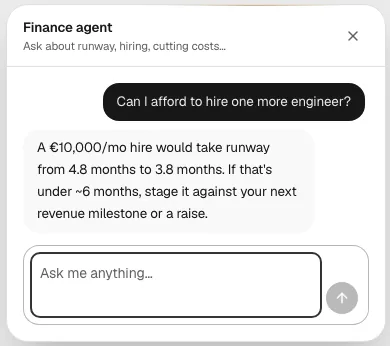
Plainhub finance agent answering whether a founder can afford one more engineer: runway falls from 4.8 to 3.8 months
The finance agent in the sample workspace, answering a hiring question. Demo answers come from built-in rules; the live agent is a language model and needs a plan.

Questions about the agent

Can an AI CFO replace a real CFO?

No. A CFO structures a raise, manages the board and makes judgment calls on things that are not in the numbers. The agent answers the questions you would otherwise work out in a spreadsheet, from the figures you have recorded, at any hour.

How is this different from asking ChatGPT?

A general chatbot has never seen your numbers, so it answers from averages or from whatever you paste in. Plainhub's agent gets your current cash, burn, revenue, team cost, spend by category and largest customers with every question, and is instructed to answer only from them.

Can my co-founder or team use it?

Only the workspace owner can open the agent. Teammates you invite see the sections you give them, but the agent reads the whole model, including salaries, so it stays with the owner.

Is it financial advice?

No. Plainhub is a modeling tool, not a licensed adviser. The agent explains what your numbers say and what a change would do to them. Decisions, and anything that needs regulated advice, stay with you and your advisers.

What does it cost?

It is included in both plans, Pro at €29.99 a month and Max at €59.99, and needs an active subscription. The homepage demo shows the agent answering from built-in rules on a sample company, so you can see the shape of it without signing up.

Ask your own numbers

Seven questions set up your model and show your runway, with no card and no bank login. The agent is there on every page of the app once you are on a plan. If you would rather check the maths by hand first, the runway calculator uses the same formula.