Published fractional CFO asking prices range from roughly $3,000 to $12,000 a month. Compare the hours and deliverables behind each quote, then calculate what the retainer takes from runway. Bring in experienced help for the judgment you need, with bookkeeping and routine tracking priced separately.
What does a fractional CFO do?
A fractional CFO does the forward-looking finance work: forecasts and scenarios, the financial model investors will pick apart, board and investor reporting, pricing and unit economics, and overseeing the finance people you already have. "Fractional", "outsourced", "virtual" and "part-time" CFO describe one service sold under different labels, so check the scope in the contract.
Fractional names the part-time arrangement, virtual names remote delivery, and outsourced says the person sits outside your payroll. Preferred CFO describes the finance roles by focus (Preferred CFO, bookkeeper, controller or fractional CFO):
| Role | Focus | Typical question |
|---|---|---|
| Bookkeeper | Transaction accuracy and completeness | Is every transaction recorded? |
| Controller | Financial control, compliance, consistency | Are the books reliable? |
| Fractional CFO | Financial leadership and decision support | What should we do next, and can we afford it? |
| Full-time CFO | The same job, for a company big enough to need it every day | The same questions, owned full time |
A bookkeeper and an accountant keep your records and file your taxes. A CFO, fractional or not, takes those records and works out what to do. If a proposal includes transaction entry or bank reconciliation at CFO rates, ask for that to be priced separately.
How much does a fractional CFO cost?
A fractional CFO costs $3,000 to $12,000 a month on published retainers, $175 to $450 an hour, or a fixed project fee, with fundraising or modeling projects running $5,000 to $25,000. Almost every published figure comes from a firm selling the service, so read them as asking prices and expect them to disagree with each other.
Hourly. Graphite Financial, which sells CFO services to startups, publishes an average of $175 to $450 an hour for 2025 and 2026. Early-stage help starts around $150, and growth-stage work runs $200 to $350. Its own FAQ gives $175 to $350 for the same average (Graphite Financial, fractional CFO hourly rates). Eightx puts SaaS, late-stage and multi-entity work at $250 to $500 an hour, and splits by experience: $150 to $250 for 5 to 10 years, $350 to $500 for 15 years and specialized.
Monthly retainer. This is the common form. Graphite quotes $3,000 to $10,000 a month for growth stage and $3,000 to $12,000 for established companies. Eightx, in a guide updated June 2026, prices by revenue (Eightx, fractional CFO cost and pricing guide):
| Company revenue | Monthly retainer (Eightx) |
|---|---|
| Under $5M | $3,000 to $5,000 |
| $5M to $30M | $5,000 to $10,000 |
| $30M to $75M | $10,000 to $15,000 |
| $75M and up | $15,000 to $20,000 and up |
Eightx assumes about 15 to 25 hours a month on a typical retainer. Preferred CFO says some engagements start at 10 to 15 hours.
Project. A fixed fee for a defined output. Eightx lists financial modeling at $10,000 to $25,000 and fundraising support at $5,000 to $20,000. Graphite says only that project pricing is flexible and negotiated.
For comparison, Graphite puts the average US full-time CFO salary at about $230,000 before benefits and equity, while Eightx counts $350,000 to $800,000 all in. Those baselines differ by a factor of two or more, which says something about how soft these numbers are.
A worked example: what it costs in runway
A fractional CFO retainer of $4,500 a month costs a seed-stage company about 1.2 months of runway. The company has $1.4 million in the bank, $70,000 of net monthly burn and about $1 million of annual revenue, so the illustrative retainer is within the early-stage range above. Without a CFO that is 20 months of runway.
| Option | Cost | Net burn | Runway |
|---|---|---|---|
| No CFO | $0 | $70,000 | 20.0 months |
| Light hourly help, 10 hours at $200 | $2,000 a month | $72,000 | 19.4 months |
| Illustrative monthly retainer | $4,500 a month | $74,500 | 18.8 months |
| One fundraising model, $15,000 once | $15,000 up front | $70,000 | 19.8 months |
The $4,500 retainer is $54,000 a year and takes about 1.2 months of runway. The one-off project takes about 0.2. Judge any of them like a part-time hire, with the arithmetic in what a hire really costs. If the CFO helps you raise on better terms, or stops one bad pricing decision, 1.2 months is cheap. If they send a monthly report you could have read off your own numbers, it is expensive.
When do you need a fractional CFO?
You need a fractional CFO when a decision depends on experience you do not have: a priced round, board reporting you cannot produce, several entities or currencies, or a large decision that is hard to reverse. The signs are below.
- You are raising a priced round and diligence questions are past your depth. A CFO who has run that round before is worth the fee.
- Your board or investors want reporting you cannot produce.
- You have several entities, currencies, inventory or debt.
- A decision is large and hard to reverse, such as a pricing overhaul or a restructure, and nobody on the team has made one before.
When can you wait on a fractional CFO?
You can wait when your question is arithmetic, such as how many months of cash you have or what a hire does to burn, or when your books are behind and a bookkeeper should come first. A CFO cannot take ownership of the numbers off you. The signs are below.
- The question you keep asking is "how many months of cash do I have?" That is a calculation, and runway is easy to keep current.
- You want to know what a hire does to burn. Draft the hire and read the new runway.
- You want someone else to own the numbers because they make you anxious. A CFO cannot take this off you, because the numbers still have to be yours.
- Your books are behind. Hire a bookkeeper first. A CFO working from late, messy records bills CFO rates to tidy them.
What software covers, and what it cannot
For the "I just need to know my numbers" stage, software covers the visibility work: cash, burn, runway and MRR recomputed as you record money in and out, and draft plans that show runway before and after a hire or a cut. Plainhub does this from numbers you type in, with no bank logins.
Its AI finance agent answers quick questions from those recorded numbers and can propose logging an expense, income or customer from a sentence, applied only after you confirm. It needs an active subscription (Pro is €29.99 a month, Max €59.99) and takes 20 questions an hour. The homepage has a demo on a sample workspace with no signup, where the agent answers from built-in rules.
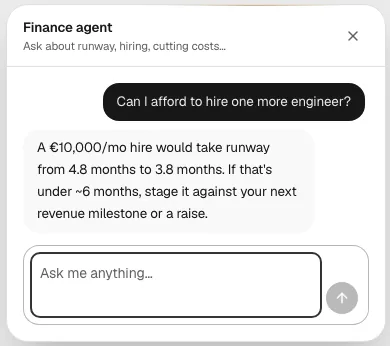
It does not replace what a CFO sells. Plainhub is not accounting software and not a licensed adviser. It will not structure a raise, handle diligence, give tax advice, support an audit or make a board-level call. A language model can also get arithmetic wrong, so check any figure you plan to act on against a draft plan. The two meet at the bottom of the stack: a founder with clean live numbers makes a CFO cheaper, because the hours go to judgment instead of rebuilding a spreadsheet.
The mistake founders make
The mistake founders make is hiring a CFO to get visibility and paying a judgment rate for it. The retainer starts, the CFO builds a model, and six months later the founder still cannot say their runway without asking. Either the numbers were never live, or the CFO owns them.
Reverse the order. Keep your own numbers current first, so you can state runway and burn on any day. Then bring in a CFO for a defined project with a defined output: a fundraise model, a pricing review or a board pack template. A few weeks of work tells you whether their judgment is worth a retainer, and costs far less than finding out six months in. If it becomes a retainer, write the monthly deliverables into the agreement (forecast update, board pack, a set number of hours) so it does not drift into paying for availability.
Next step
If you do not know your runway today, start there: the cash runway calculator gives an estimate from three inputs. If you can state it, and a decision in front of you needs experience you lack, get quotes from at least two firms and ask each what hours and deliverables the retainer includes.