The true cost of an employee includes employer taxes, benefits and tools, with recruiting and equipment added when they are paid. Convert the ongoing cost to a monthly figure before checking runway. This UK example turns a £60,000 salary into about £5,948 a month and reduces runway from 15.0 to 12.1 months after one-offs.
The rest of this post builds that figure one line at a time, so you can redo it with your own salary, country and bank balance.
What does a hire really cost on top of salary?
The loaded cost of a hire is the salary plus every recurring line the employer pays. In this UK example, a £60,000 salary (£5,000 a month, the only number the candidate sees) becomes £71,370.90 a year, or £5,947.58 a month, once employer National Insurance, the minimum workplace pension and £150 a month of tools are added.
| Line | How it is worked out | Per year | Per month |
|---|---|---|---|
| Salary | From the offer | £60,000 | £5,000 |
| Employer National Insurance | 15% of pay above £5,000 | £8,250 | £687.50 |
| Workplace pension, employer minimum | 3% of earnings between £6,240 and £50,270 | £1,320.90 | £110.08 |
| Software seats and tools | Your own stack; £150 a month here | £1,800 | £150 |
| Recurring total | £71,370.90 | £5,947.58 |
The employer National Insurance rate and the £5,000 secondary threshold are HMRC's figures for the 2026 to 2027 tax year (GOV.UK, rates and thresholds for employers). The 3% employer minimum and the £6,240 to £50,270 earnings band come from the auto-enrolment rules (GOV.UK, workplace pensions). Your pension scheme may define earnings differently or pay more than the minimum, so check it.
This hire costs 1.19 times salary every month, before anything one-off. In the US the statutory floor is lower: the employer pays 6.2% Social Security on wages up to $184,500 in 2026 and 1.45% Medicare on all wages (IRS Topic 751), with unemployment taxes and any health insurance you offer on top. Every country has its own lines. Find the statutory ones on your tax authority's site, then add your own tools.
Then come the costs you pay once:
- A laptop and setup, £1,800 in this example.
- An agency fee, if you use a recruiter. This example uses 15% of salary, £9,000, as an input; your contract sets the real figure.
That is £10,800 gone from the bank before the first payslip.
How do you work out runway after a hire?
To find runway after a hire, take the one-off hiring costs off your cash and divide by the net burn plus the hire's loaded monthly cost. The company in this example has £420,000 in the bank and spends £28,000 a month more than it brings in, so a £5,948-a-month hire cuts its runway from 15.0 to 12.1 months.
| Before the hire | After the hire | |
|---|---|---|
| Cash | £420,000 | £409,200 (after £10,800 of one-offs) |
| Net burn | £28,000 | £33,948 |
| Runway | 15.0 months | 12.1 months |
runway = (cash - one-off hiring costs) / (net burn + loaded monthly cost)
       = (420,000 - 10,800) / (28,000 + 5,948)
       = 12.1 months
One person costs this company three months of runway. That can be the right trade, and it should be made with this table open.
The employee cost calculator includes a UK mode for employer National Insurance and qualifying-earnings pension contributions. In its percentage-based mode, enter the employer rate, benefits, equipment and recruiting that apply to your hire. Use the recurring monthly result in your runway calculation.
In Plainhub you can also ask the finance agent to rerun runway with the hire, which answers from the numbers you have recorded.
What does a hire have to earn back?
A hire that is meant to pay for itself has to earn back more than the salary. To cover its ongoing monthly cost, the role needs about £5,950 of extra gross profit or equivalent savings. Recovering the £10,800 of one-offs requires additional profit.
For a SaaS company with an 80% gross margin, that means £5,948 / 0.80, or about £7,435 of new monthly recurring revenue. At an average of £400 a month per customer, that is 19 new customers. Then ask by which month this person could plausibly have added 19 customers, or shipped the thing that wins them. Every month before that date is paid at full price.
Some roles never pay back this directly. A support hire who keeps churn down, or an engineer who fixes the part of the product sales is stuck on, can still be the right call. Write down which kind of hire this is before you make the offer, because "we'll see" turns into a year of payroll quickly.
Where the estimate usually goes wrong
A hire cost estimate usually goes wrong in three places: using the average cost of your team instead of the cost of this hire, treating the start date as the cost date, and losing the loaded cost after the offer is signed.
Using the average cost of your team instead of the cost of this hire. The UK Employment Allowance lets eligible employers take up to £10,500 off their employer National Insurance bill in 2026 to 2027 (GOV.UK). A company with two or three staff may pay little or no employer NI today, so its current payroll looks cheap. Once the allowance is used up, each new hire pays the full 15%. It also has eligibility rules: a company whose sole director is the only employee paying secondary NI cannot claim it (GOV.UK, Employment Allowance eligibility).
Treating the start date as the cost date. Recruiting fees, equipment and notice periods fall before day one. If you agree a hire who starts in three months, the one-offs may already be paid while the salary has not started, and your runway should show both.
Losing the loaded cost after the offer is signed. The salary goes into payroll software. The pension, the NI and the extra seat end up in three other places, and six months later nobody can say what the team costs. Record the loaded figure against the person.
What should you do before you send the offer?
Before you send an offer, work out the loaded monthly cost of the hire, take the one-off costs off your cash, divide to get the new runway, and write down what the hire has to produce and by when. For the £60,000 engineer that means £5,948 a month loaded, £10,800 of one-offs and 12.1 months of runway.
- Build the table above with your own salary and your country's employer costs.
- Add the one-offs and take them off cash.
- Divide to get the new runway, and decide whether you can live with it.
- Write down what the hire has to produce, and by when.
If the role is part-time finance help rather than a payroll hire, what part-time finance help costs in runway works the same sum.
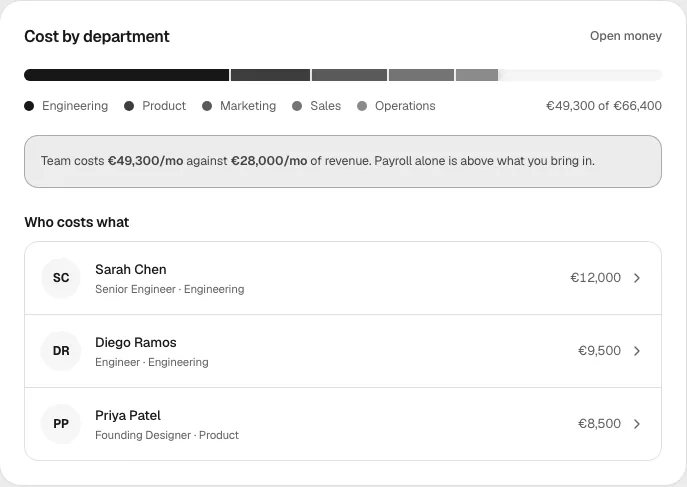
In Plainhub, the People page holds one monthly cost per person, so enter the loaded £5,948 rather than £5,000; the page then shows team cost by department and its share of burn. A hire can sit on the Plans page as a draft first. The draft shows runway before and after without touching your live numbers, and once you commit it, the cost joins your burn from its start date. If you only need the arithmetic, the payroll percentage calculator shows what the hire does to payroll as a share of revenue, and when will I run out of cash covers the runway date itself.