Use a monthly business review to explain what changed in cash, burn, runway, MRR and customer concentration. Put each figure beside last month's, then leave with a decision, an owner and a date. The example below uses a 30-minute agenda and includes a one-page report template you can copy.
The point is to find out early which way the company is heading. Paul Graham wrote that half the founders he talks to do not know whether they are default alive or default dead (Default Alive or Default Dead?, 2015). A regular review gives you a scheduled moment to check the answer.
The company
The example is a seed-stage B2B software company with seven people. It plans to start its next fundraise in March, and the founders assume a round takes about four months from first meeting to money in the bank. The review takes place on 1 October.
What are the five numbers in a monthly business review?
In the first ten minutes, write down five numbers and their change since last month: cash in the bank, net burn as a three-month average, runway, MRR and the largest customer's share of MRR. On 1 October the example company's runway fell from 12.0 to 9.8 months, a loss of 2.2 months in one calendar month.
| Number | 1 September | 1 October | Change |
|---|---|---|---|
| Cash in bank | €412,000 | €371,500 | -€40,500 |
| Net burn, three-month average | €34,200 | €37,900 | +€3,700 |
| Runway | 12.0 months | 9.8 months | -2.2 months |
| Zero-cash month | early September next year | late July next year | about six weeks earlier |
| MRR | €21,400 | €22,300 | +€900 |
| Largest customer's share of MRR | 23.8% | 26.9% | +3.1 points |
Net burn is a three-month average because single months are noisy: one annual invoice can make a normal month look alarming. Runway is written as a month because "late July" gets a reaction that "9.8 months" does not. The runway guide covers how to turn one into the other.
Find current cash, monthly net burn, runway, MRR and concentration on a live dashboard. Keep prior months and any three-month average in your review document.
Notice the runway line. One calendar month passed, and the zero-cash date moved six weeks closer, so the company lost 2.2 months of runway in one month. That is the number the rest of the review has to explain.
Minutes 10 to 20: what moved and why
In the second ten minutes, give every change in the five numbers one line saying what moved and why. If a line reads "not sure", finding out is homework for this week. Then compare the runway date with the next milestone.
- Cash down €40,500. Normal operations cost €34,500. The other €6,000 was the annual renewal for the design tools, which nobody had on the calendar. It is on the calendar now.
- Burn average up €3,700. September was the first full month of the engineer who started in mid-August. Planned.
- MRR up €900. Two new customers added €1,000, the largest account added seats worth €900, and one customer cancelled (€1,000, moved to a competitor on price).
- Largest customer's share up 3.1 points. Their expansion plus a small customer leaving. Still under 30%, but it has risen for three months running, so it goes on next month's watch list. The concentration guide covers when it becomes a problem.
Plainhub's finance agent explains the current recorded figures. It does not receive prior months or a transaction history, so use your review notes to explain what changed.
Last month, starting the raise in March meant closing around July, two months before the old zero-cash date. This month the zero-cash date is late July, so a March start closes the round the month the money runs out.
The item that is not in the numbers yet
Add anything signed, promised or decided but not yet paid before you read the runway. In the example, the founders signed an offer last week with a designer who starts on 1 November at €5,500 a month, all-in. None of that is in September's burn, so none of it is in the table.
net burn with the designer = 37,900 + 5,500 = €43,400
runway                     = 371,500 / 43,400 = 8.6 months
zero-cash month            = mid-June next year
Counting the designer from today is slightly pessimistic, since he starts in November, but not by enough to change the answer: with the hire included, a March start closes the round about a month after the cash is gone. This is the step most reviews skip: anything signed, promised or decided but not yet paid has to be added before you read the runway, or next month's numbers will surprise you with something you already knew.
Minutes 20 to 30: one decision
End the review with one decision that says what, who and by when. In the example, the options on the table were to delay the designer, cut other spending, or start fundraising earlier. The founders chose one and wrote it as a single sentence:
Move the fundraise start from March to January. The CEO books the first investor meetings for the week of 12 January.
With a January start and their four-month assumption, the round closes around mid-May: about a month before the mid-June zero-cash date with the designer, and over two months before late July without. The designer stays. If January slips, delaying the hire is the first item for the November review.
One decision a month sounds small. Over a year it is twelve corrections, each made while it was still cheap to make.
The blank version
The blank monthly review is a five-row table (cash in bank, net burn, zero-cash month, MRR and the largest customer's share) with last month, this month, change and why, followed by three written questions and one decision. Copy this into a running document, one section per month.
| Number | Last month | This month | Change | Why |
|---|---|---|---|---|
| Cash in bank | ||||
| Net burn, three-month average | ||||
| Zero-cash month | ||||
| MRR | ||||
| Largest customer's share |
Then answer three questions in writing:
- What moved, and do I know why? One line per change.
- Where is the zero-cash month against the next milestone (fundraise, launch, break-even)?
- What have I signed, promised or decided that is not in these numbers yet? Add it and recalculate.
End with one decision: what, who, and by when.
How do you write a one-page monthly financial report?
A monthly financial report is the same five numbers written down for someone else, usually a board or investors, and it should fit on one page, with three sentences of commentary and one ask. The review above is for you. Copy this:
Monthly financial report: [Company], [Month Year]

| Number                          | Last month | This month | Change | Why (one line) |
|---------------------------------|-----------|------------|--------|----------------|
| Cash in bank                    |           |            |        |                |
| Net burn (3-month average)      |           |            |        |                |
| Runway (month cash hits zero)   |           |            |        |                |
| MRR                             |           |            |        |                |
| Largest customer's share of MRR |           |            |        |                |

Commentary (three sentences)
1. What changed: the one or two moves that explain most of the difference.
2. What it means: where the runway month sits against the next milestone.
3. What we are doing: the decision, who owns it, and by when.

Ask: one thing you want from the board (an intro, advice, a decision).
The order matters. Cash and runway come first because that is the question every reader has. Burn comes next because it explains runway. MRR and concentration come last because they explain burn and tell the reader whether the runway is safe. If the largest customer's share is at or above 30%, say so in sentence two and give the runway without them, as in the concentration guide. If the update quotes a run rate, how investors read a run-rate claim lists what they will check.
Three sentences of commentary is a hard limit, not a target. A board member can read a table in a minute, so the sentences should say what the table does not: the reason, the consequence and the decision. If you cannot write sentence three, you have not made the decision yet.
What goes where:
| Audience | Gets | Does not get |
|---|---|---|
| Board | The one-page table, three sentences, the ask | Line-by-line spending, individual salaries |
| Team | The same top-line runway and the decision, in plain words | Investor-specific asks, anything about individual pay |
| You alone | Contract dates, notice periods, the full spend list | Nothing, this is the working file |
That split is a suggestion from how founders run these, not a rule: some boards want the spending breakdown, and some companies share everything with the team. Pick it once and keep it the same every month, so a change in the numbers is the only thing that changes.
If you use Plainhub, the Max plan exports a PDF report with cash, burn, MRR, ARR, spending, revenue, team cost and a twelve-month cash projection. It can serve as an attachment behind the one page, with your three sentences on top. It is a snapshot of the model, not a board pack, so the commentary and the ask are still yours to write.
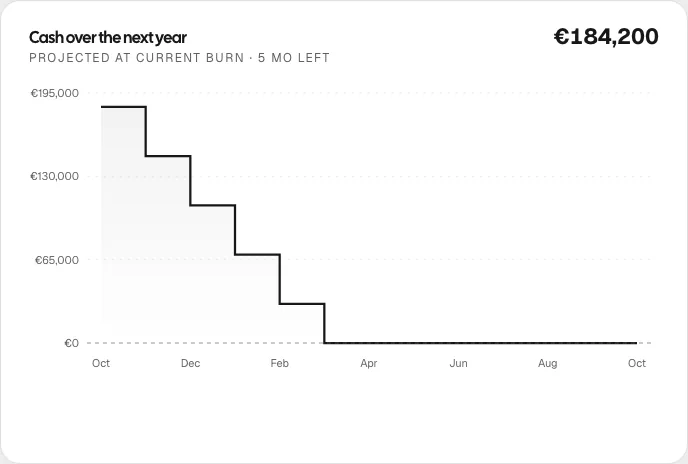
How do you keep a monthly review going?
Keep a monthly review going by booking it as a recurring 30-minute meeting on the first working day of each month and treating it like an investor meeting. Keep every month in the same document. After a year you have a plain record of what happened to the company and why, and most of an investor update is already written each month.
The usual failure is spending the 30 minutes collecting numbers instead of reading them. If that happens, fix the collection. In Plainhub, cash, net burn, runway, MRR and your largest customer's share are current whenever you open it, because they recalculate as you record what happens. A signed hire like the designer can go in as a draft plan, which shows the runway with it before it affects your real numbers. On the Max plan you can also export the PDF report (cash, burn, MRR, ARR, spending, revenue, team and a twelve-month cash projection) and file it with that month's notes.